
Best Nail Guns for Home DIY: Brad, Finish, and Framing Nailers Compared
Quick summary: Brad nailers suit lightweight trim and craft work, finish nailers handle furniture and cabinetry, and framing nailers are built for decking and structural timber. For most home DIYers starting out, a cordless brad nailer like the Ryobi 18V ONE+ Brad Nailer offers the best mix of convenience and value, while serious deck builders should look at a pneumatic framing nailer such as the Paslode Framing Nailer for speed and power. Expect to spend anywhere from $150 to $600 depending on the tool and power source.
Nail guns used to feel like a tradie-only purchase. These days, with cordless brushless motors and decent battery life, they've become genuinely practical for weekend renovators too.
If you're still swinging a hammer for your skirting boards or deck frame, it's time to reconsider.
Why Upgrade from Hand Nailing to a Nail Gun
Hand nailing works, but it's slow, inconsistent, and tough on timber. One mistimed swing can split a piece of moulding you've just spent twenty minutes cutting to fit.
A nail gun drives a fastener in a fraction of a second, with consistent depth every time. That means fewer blown-out boards, less bruising on soft pine, and a much faster finish on repetitive jobs like architraves, decking boards, or stud framing.
There's also a safety angle most people don't expect. Modern nail guns have sequential triggers and contact safety tips that prevent accidental discharge — arguably safer than a hammer swinging near your fingers.
Pneumatic vs Battery-Powered Nailers
Pneumatic nail guns connect to an air compressor via a hose. They're generally cheaper to buy, lighter in the hand, and very reliable — but you're tethered to a compressor, which adds cost and clutter.
Battery-powered (cordless) nailers are self-contained. No hose, no compressor, just a battery and the tool. They cost more upfront but are far more convenient for one-off home projects or working up a ladder.
For most DIYers without an existing compressor, cordless is worth the premium. If you already own a compressor for other tools, pneumatic will save you money.
Brad Nailers for Trim and Moulding
Do I need a brad nailer or a finish nailer for trim work?
Brad nailers fire thin 18-gauge nails, typically 15–50mm long. They're designed for lightweight trim — think quarter round, small mouldings, cabinet backing, and craft projects where you don't want visible holes.
Because the nails are so fine, brad nailers leave barely-there holes that often don't need filling. The trade-off is holding power — they're not strong enough for structural work or heavy skirting boards.
If your trim is thicker (like 90mm+ skirting or door architraves), you'll want a finish nailer instead. As a rule of thumb: brad for delicate, finish for substantial.
Best Brad Nailers Available in Australia
The Ryobi 18V ONE+ Brad Nailer is a strong entry point at around $199 (tool only, from Bunnings), especially if you already own Ryobi ONE+ batteries. It handles 15–50mm brads and has enough punch for most interior trim.
For a pneumatic option, the Bostitch BTFP12233 Brad Nailer kit runs about $249 at Total Tools and includes a compressor-ready fitting, oil, and case. It's a favourite among renovators for its consistent depth control dial.
Budget-conscious buyers can look at the Ozito PXC 18V Brad Nailer (around $129 at Bunnings) — it won't match the fit and finish of the bigger brands, but it's a sensible way to try a nail gun before committing to a pricier kit.

Finish Nailers for Furniture and Cabinetry
Finish nailers step up to 15 or 16-gauge nails, usually 32–65mm long. They're the go-to for furniture building, cabinetry, thicker skirting boards, and door jambs — anywhere you need more holding strength than a brad but don't want the bulky head of a framing nail.
The slightly larger nail does leave a more visible hole, so you'll generally need a dab of filler before painting.
Best Finish Nailers Available in Australia
The Makita DBN600Z 18V Finish Nailer is a popular cordless choice at roughly $349 (skin only), pairing well with Makita's LXT battery range if you already own their drills or saws.
For pneumatic power, the Paslode F350S Finish Nailer is a long-time trade favourite, priced around $429 at Total Tools. It's heavier duty than most DIY-grade options and will outlast cheaper tools if you're planning multiple furniture or cabinetry projects.
If budget is tight, the DeWalt DCN660 18V Finish Nailer (around $299 skin only) is a solid middle ground — reliable brand, fair price, widely stocked at Bunnings and Total Tools.
Framing Nailers for Decking and Structural Work
Can you use a framing nailer for building a deck yourself?
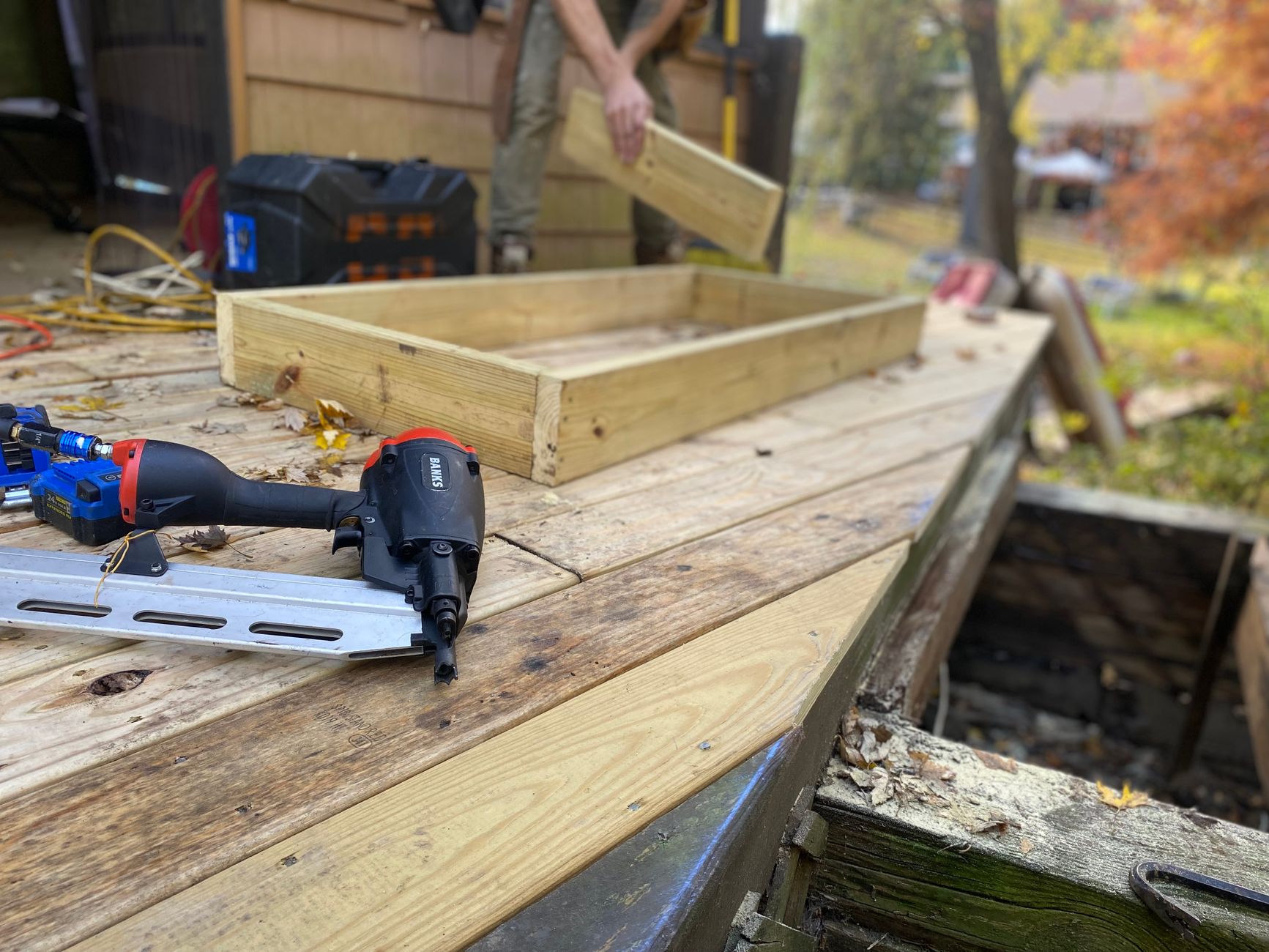
Yes — in fact, framing nailers are the standard tool for deck construction, even among professional builders. They fire thicker 30–90mm nails capable of punching through treated pine joists and bearers without pre-drilling.
For DIYers building a deck, a framing nailer will cut your build time dramatically compared to a hammer, and the depth adjustment means you can set nails flush without over-driving them through hardwood decking boards.
Just be aware these are powerful tools — kickback is real, and you'll want to read the manual properly before starting.
Best Framing Nailers Available in Australia
The Paslode Framing Nailer (often sold as the Impulse or Cordless Framing kit) is the benchmark tool here, priced around $599–$649 depending on retailer. It uses a gas fuel cell instead of a compressor, which makes it genuinely portable — handy if you're working at the back of a block away from power.
For a pneumatic alternative, the Bostitch F21PL Framing Nailer sits around $399 at Total Tools and is a well-regarded choice if you already have a compressor set up in the shed.
Ozito and other budget brands do make cheaper framing nailers (from around $249), but for structural decking work, it's worth spending a bit more on a tool with proven reliability — this isn't the place to risk a jam halfway through a joist.
Choosing the Right Nail Gun for Your Project
What is the best nail gun for a beginner DIY enthusiast in Australia?
For most beginners, a cordless brad nailer is the smartest first purchase. It covers the widest range of common home jobs — trim, shelving, small furniture repairs — without the expense or bulk of a compressor.
If your first big project is a deck or a pergola, skip straight to a framing nailer instead; a brad nailer simply won't have the power you need.
Is a cordless nail gun better than a pneumatic one for home use?
For occasional home use, cordless generally wins on convenience. No compressor to buy, no hose to drag around the yard, and you can use it on a ladder or in tight spaces without tripping over anything.
Pneumatic tools still make sense if you already own a compressor, do frequent larger projects, or want to save money upfront — pneumatic nail guns are typically $100–150 cheaper than their cordless equivalent.
Price Comparison and Where to Buy in Australia
| Nail Gun Type | Example Model | Price (AUD) | Best For |
|---|---|---|---|
| Brad Nailer (cordless) | Ryobi 18V ONE+ Brad Nailer | ~$199 | Trim, moulding, craft |
| Brad Nailer (pneumatic) | Bostitch BTFP12233 | ~$249 (kit) | Trim with existing compressor |
| Finish Nailer (cordless) | Makita DBN600Z | ~$349 | Furniture, cabinetry |
| Finish Nailer (pneumatic) | Paslode F350S | ~$429 | Heavy trim, cabinetry |
| Framing Nailer (gas) | Paslode Framing Nailer | ~$599–649 | Decking, framing |
| Framing Nailer (pneumatic) | Bostitch F21PL | ~$399 | Decking with compressor |
How much does a decent nail gun cost in Australia?
Budget around $150–250 for an entry-level brad or finish nailer, $300–450 for a mid-range cordless finish or framing tool, and $500+ for a premium gas-powered framing nailer like the Paslode.
Bunnings, Total Tools, Mitre 10 and Amazon AU are the most reliable places to buy, and it's worth checking Total Tools' trade pricing if you're buying more than one tool — they often price-match and throw in battery bundles.
Safety Tips for Using Nail Guns at Home
Always use the sequential trigger mode rather than bump-fire mode for home projects — it's slower but far safer, requiring a deliberate squeeze for each nail.
Keep your free hand well clear of the firing point, and never bridge the safety tip with your fingers to force a shot into an awkward corner.
Wear safety glasses every time. Nail guns can occasionally send a fastener skimming off hardwood or knots, and eye protection is non-negotiable.
Disconnect the battery or air hose before clearing a jam, and store the tool with the magazine empty when not in use, especially if kids are around the workshop.
Bottom Line
For general home DIY, a cordless brad nailer covers the most ground — trim, mouldings, light furniture — and is the easiest to justify buying first. Step up to a finish nailer once you're building furniture or installing heavier skirting, and only invest in a framing nailer if decking or structural carpentry is on your project list.
Whichever you choose, match the tool to the job rather than buying the biggest one available. A $600 framing nailer is wasted on picture frame trim, just as a brad nailer won't survive a deck build.


